Ramsden Crags
A Woman of SubstanceRamsden Crags is a landmark of the Yorkshire moors and one of the most persistent places in Emma Harte’s inner life. Known locally as Flying Horses and, in Emma’s family, as The Top of the World, it offers a high, open counterpoint to illness, danger, and confinement. Its significance grows through recurring visits and memories: it is at once a view from the moors, a refuge imagined for the sick, the setting for a discovery shared by Emma and Edwin Fairley, and a landscape that keeps the past vivid decades later.
Setting and Names
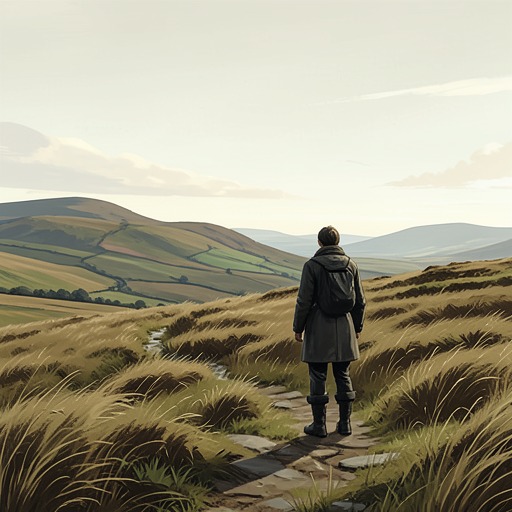
Seen from the high ground above Fairley village, the crags rise in a distinctive formation that gives the place its competing names. When Emma and Blackie O’Neill emerge from Ramsden Ghyll onto the plateau, she points out the distant rocks. In the brightening northern sky, their shapes suggest enormous horses rearing against the horizon. Blackie sees the same likeness, while Emma explains that villagers call the formation Flying Horses and that her mother calls it The Top of the World. The names register different kinds of attachment: one belongs to local description, the other to Emma’s intimate family geography.
The approach helps define the place as part of a larger moorland landscape rather than an isolated landmark. A steep track climbs out of Ramsden Ghyll onto a broad plateau extending toward Fairley Hall. In winter, the route is rough with embedded roots and scattered rocks; the wind clears the mist and opens the view across the hills. Ramsden Crags is both a destination visible across this terrain and a point encountered along perilous paths over it.
Refuge and the Measure of Loss
The crags acquire emotional force as a place of imagined restoration. During Elizabeth Harte’s illness, Jack Harte feels an urgent impulse to carry her from her mean room to the high moors. He imagines the air there reviving her, and pictures them sheltered by the crags among heather, ferns, and bilberry leaves, with linnets and larks nearby. The season makes that refuge inaccessible: in February, the ground is frozen and the moorland is bleak beneath rain-filled skies. The contrast between the remembered summer landscape and the actual winter weather gives the setting the force of a hope that love cannot make practical.
Much later, when Emma is seventy-eight and gravely ill, the crags return in a dream. She becomes her sixteen-year-old self, running across the moors toward Edwin, who is climbing toward their ledge beneath the crags. She reaches him breathless; he welcomes her there and imagines that they will live forever. The dream breaks apart as Emma falls into deep sleep. After surviving another attack of bronchial pneumonia and leaving the London Clinic three weeks later, she silently credits her recovery to the will to live. In this late scene, the childhood landscape is not simply recalled: it gives shape to Emma’s determination to survive, even as the dream’s promise of permanence is shadowed by age and illness.
Encounters, Flight, and Discovery
Ramsden Crags also marks a turning point in Emma’s early encounters with other people. After she and Blackie have climbed out of the Ghyll, the view gives her a moment to look at him more closely. Having initially been frightened by the young Irishman, she now sees him as an extraordinary figure. The pause at the edge of the moors shifts the scene from escape and exertion toward curiosity and recognition.
On another urgent crossing, Emma runs toward the crags while trying to reach her sick mother. She plunges through the dark of Ramsden Ghyll, climbs out into sunlight, and continues along the high path despite impaired breathing. At the crags she stops to recover; Blackie arrives on horseback with Frank Harte in front of him and helps Emma mount. The landmark is a brief resting point in a journey made under pressure, and the route from it carries the group onward to Top Fold.
The crags become a place of deliberate exploration when Edwin tests his belief that a central rock is separate from the formation. With a hammer, chisel, and other tools, he works at a stone about four feet high and two feet wide. Emma doubts that moving it will reveal anything beyond more rock. Edwin persists, and the stone eventually topples forward, uncovering an opening about eighteen inches wide and two feet high. Inside the small tunnel he finds a shilling and a nail. The discovery turns the familiar landmark into a concealed space and gives Emma and Edwin a shared act of investigation at a place already bound to their lives on the moors.
Memory and Narrative Significance
The cave’s history continues beyond Emma and Edwin’s discovery. Decades later, Edwin brings Adam Fairley a painted pebble he found in the old cave near Ramsden Crags. Looking at it, Adam is carried back to a memory of a woman beneath the crags and recalls her telling him that she was going to have a baby. Edwin wonders whether the image is of Olivia Wainright, but Adam does not explain the story; he returns the pebble to Edwin and says the time is not right. The object makes the cave more than a hiding place: it has preserved a material trace that draws an unfinished personal history into the present.
The crags therefore gather several different kinds of passage. Characters cross the surrounding moorland in flight or in search of one another; the stone opening reveals a hidden interior; and memory carries scenes from youth into old age. Their changing weather and difficult approaches keep the place physical and specific, while its repeated association with shelter, discovery, and recalled love makes it a landmark in both the plot and Emma’s sense of her own life.